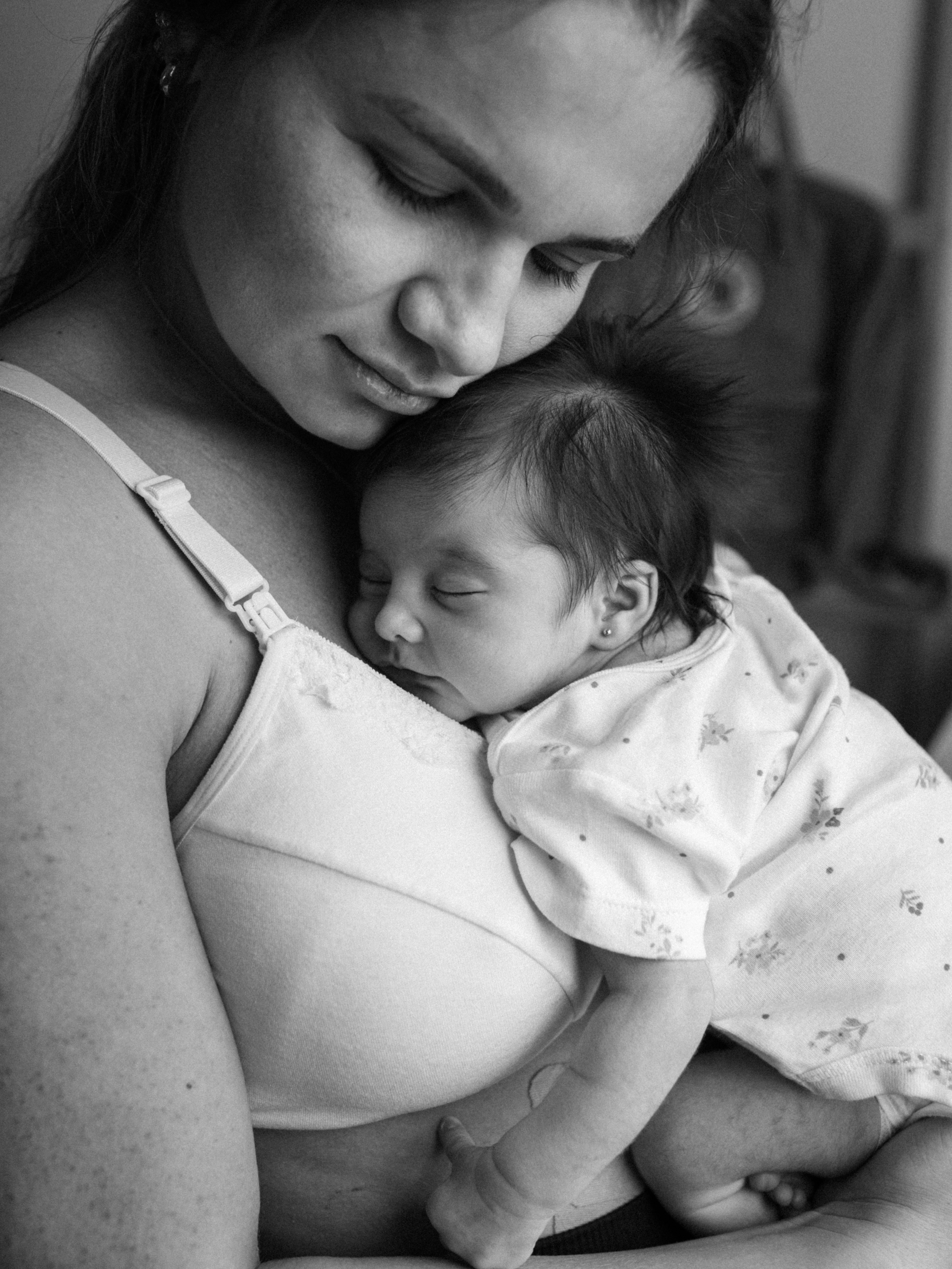
A body that grew a life, carrying the life it grew; Photo by Jonathan Borba on Unsplash
Becoming a new parent comes with a side of unsolicited advice, often delivered with the confidence of a Nobel laureate. How many times have we new mothers heard things like, ‘Let him cry, it will make his lungs stronger’ as if my baby is training for the Olympics…. in screaming?
Or the classic, ‘Don’t pick him up, he’ll start manipulating you’, yes, of course, like my tiny potato is clearly plotting a full psychological takeover from his crib.
Or ‘don’t drink cold water, it will freeze the milk inside’. Sure. And if I drink hot water, will it turn into tea?
And my personal favorite, ‘Don’t kiss the baby too much, he’ll get used to love’. Ah yes ‘Love’, I must keep him emotionally dehydrated. Very important.
Postpartum isn’t just sleepless nights and healing bodies but it’s also surviving an avalanche of advice you never asked for. At a time when new mothers need love, reassurance, and gentleness, they often get served a buffet of unsolicited advice, seasoned with judgmental pressure and zero logic.
History hasn’t helped. Back in the 1920s, John Watson insisted on strict schedules and minimal cuddles. Fast forward to the 1980s, and Dr. Ferber popularized the “cry-it-out” method. Apparently, turning babies into miniature, sleep-deprived experiments was considered cutting-edge science. And now, generations of well-meaning elders want us to repeat it
Modern research suggests babies need love, responsiveness, and emotional nurturing to thrive. Ignoring their cries spikes stress hormones, disrupts sleep, and can affect emotional and feeding patterns, not exactly the recipe for a “strong character.
And then there’s the famous “We’ve come to help.”
Help, in this context, has a very specific definition. It means holding the baby only when the baby is calm, while the postpartum mother is gently reminded of the household chores she apparently abandoned while giving birth. It’s very much like someone with a broken arm asking for help, and people responding by proudly holding the cast, declaring the burden lifted, and suggesting the injured person take advantage of their newfound freedom to get some work done.
The baby is cradled lovingly as long as he smiles. The moment he cries, or demands milk, he is returned with impressive speed. Here, he wants you.
So while the mother is still healing, still bleeding, still learning her own body again, she’s told to rest, but also to cook, clean, and “move a little, it’s good for you.” Because nothing says postpartum care like cooking entire buffet while someone else rocks your baby and calls it support. It’s a curious kind of help…. one where the mother ends up more exhausted than before, and the baby gets passed around like a teacup, while the person who actually needs care is expected to be grateful.
And God forbid she says something back. Then the whispers begin: why is she being so weird? She wasn’t like this before the baby. Yes, she has become different. Because childbirth doesn’t just give you a baby, it gives you exhaustion, pain, hormones doing gymnastics, and a brand-new intolerance for nonsense.
And just when you think you’ve survived the advice and help Olympics, enter its quieter cousin: the constant, low-grade nagging. Not loud enough to start a fight, but persistent enough to live rent-free in your head.
It usually sounds innocent.
“Did you prepare his food?”
“You should feed him again.”
All asked with complete confidence, despite the fact that the baby ate exactly five minutes ago, and the mother… shockingly, knows this. It’s as if motherhood comes with an invisible disclaimer: Your internal clock, instincts, and lived experience are all temporarily suspended. Please consult the nearest relative.
And then comes the nostalgia-based nutrition advice. “I gave my children this, and they were absolutely fine.”
Every growth stage unlocks a new level of commentary, but nothing compares to the moment the baby starts solids.
“Give him this.”
“No, no, give him that.”
“Mix this with that.”
“Add oil.”
“Add salt.” and it goes on…..
What seems incredibly hard to understand is that even after six months, a baby’s primary food is still mother’s milk. But relatives behave as if the baby has a flight to catch tomorrow and must become nutritionally independent immediately. The urgency is baffling. Hello , he is still wearing diapers. Let’s not rush him into adulthood.
They also recommend introducing a new food every single day, preferably all at once, blended into a mysterious potion. Never mind that babies need one food at a time, for several days, so reactions can be observed.
And the most fascinating part? Much of this advice comes from mothers-in-law. Which is surprising, because they were once young mothers too. Tired, overwhelmed, trying their best. Somewhere along the way, empathy seems to have been replaced with a clipboard and a whistle.
Another personal favorite: once solids are introduced, people assume the baby can now be fed all day. Milk? Optional. Mother? Replaceable. The goal, it seems, is to make the baby “independent” as soon as possible, often less for the baby’s benefit and more so others can keep him longer. As if the baby is a source of entertainment, not a human being with needs, rhythms, and attachments.
And in all this noise, every single day, a mother has to find the strength to smile, explain, refuse, repeat, or sometimes just stay silent. And if she’s tired, vulnerable, or doubting herself….. she caves. Not because she’s weak, but because she’s exhausted from constantly defending her motherhood.
Another quietly disheartening thing for mothers is how a baby’s attachment to them becomes a punchline. When a baby naturally seeks comfort in the person whose heartbeat he knows better than his own, it’s treated less like biology and more like a character flaw.
“Oh, he only wants his mother.”
Yes, how dare a newborn prefers the woman whose body literally built him.
Mornings are no kinder. After a night of broken sleep, feeding sessions, and decoding every aah and uuh like it’s Morse code, a mother finally sits down to eat. Not out of luxury, out of survival. God forbid she takes a bite before feeding the baby.
That’s when the jokes arrive.
“Bad Mommy! Eating yourself and not feeding the baby.”
Except the joke quietly ignores the fact that the “bad Mommy” is eating so she can feed the baby. Because milk doesn’t appear by magic. It comes from calories, hydration, and a body that hasn’t been completely drained of energy. But of course, if she doesn’t produce enough milk, there’s always the unspoken solution: We can switch the baby to alternatives. Problem solved.
And then there’s that moment. The mother is holding the baby sometimes for comfort, sometimes simply because she wants to exist in the same space as her child. Instantly, a hand appears.
“Give him here.”
“Let me take him.” Sometimes not even words but already grabbing the little born from the mother’s arm.
And if she hesitates… just a little…. if she doesn’t immediately surrender the baby, the atmosphere changes. Smiles tighten. Jokes are cracked. Faces are made. The unspoken message floats in the air: You’re being ‘weird and difficult’.
Because how dare she want to hold her own child.
It’s fascinating how a baby becomes community property the second he’s calm. But the moment he cries? Ah. Emergency protocol activated. The baby is swiftly returned, like a package marked Handle With Care.
“Here, he wants his mother.”
Apparently, a crying baby is exclusively the mother’s responsibility, but a happy baby is everyone’s entertainment.
And heaven forbid the baby says “mama” first. That’s when the real campaign begins.
“No no, say papa.”
“Papa, papa, papa!”
Repeated endlessly, with the enthusiasm of a political slogan. Because clearly, a baby choosing “mama” is not biology, it’s bias. This imbalance must be corrected immediately.
Never mind that “mama” is often the easiest sound for babies to form. Never mind that the baby recognizes the voice, the smell, the arms. No, no, this is clearly a conspiracy. And it must be fixed with aggressive repetition.
The list is long. The world may stay exactly as it is, loud and certain, but a mother changes. She grows into her strength, protecting her instincts the way only love teaches her to do.
 Felice Bambino
Leave a comment